

Medically Reviewed by: Clinical Editorial Team, 24 Hour Meds
Fact-Checked via: Therapeutic Goods Administration (TGA) Guidelines & Australian Medicines Handbook (AMH)
Last Updated: August 2026
If you have searched for ivermectin online over the past few years, you have likely run into a wall of conflicting information. Between media debates and shifting public health rules, it is easy to overlook a basic clinical fact: ivermectin is a standard, widely used prescription medicine with a decades-long track record in human healthcare.
Its discovery in soil samples during the late 1970s was such a massive leap forward for global medicine that the scientists behind it were awarded the Nobel Prize in Physiology or Medicine in 2015.
So, what is ivermectin actually prescribed for in humans today? How does it work inside the body, and what are the current rules for getting a prescription in Australia? Let’s break down the facts.
What Is Ivermectin and How Does It Work?
At its core, ivermectin is an antiparasitic medication. It belongs to a class of compounds called avermectins, which target the nervous system of specific parasites—primarily parasitic worms, mites, and insects.
When taken as an oral tablet, the active medicine enters your bloodstream and binds selectively to glutamate-gated chloride ion channels in the parasite’s nerve and muscle cells.
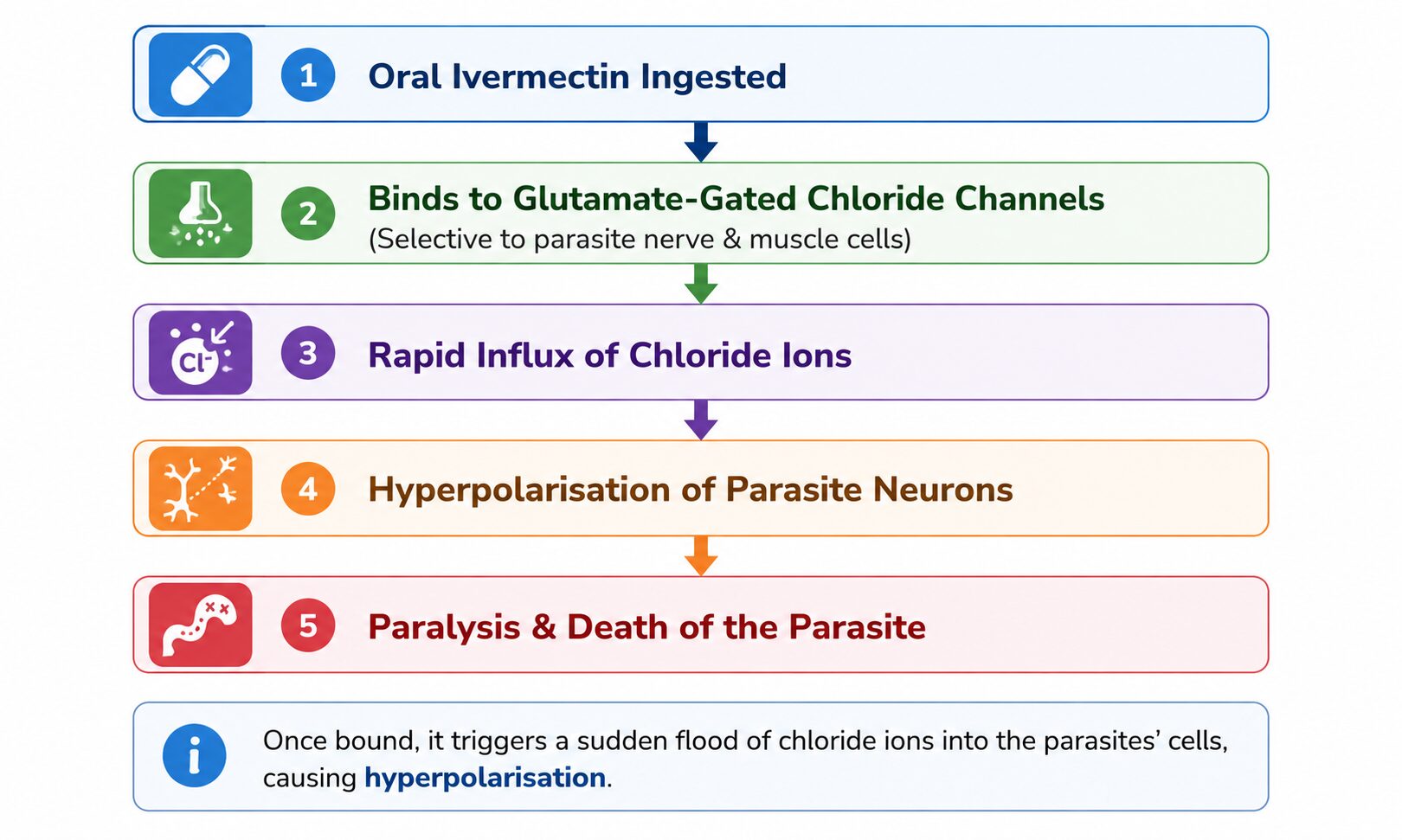
Once bound, it triggers a sudden flood of chloride ions into the parasite’s cells, causing hyperpolarisation.
In simple terms? It paralyzes the parasite.
Once paralyzed, the parasite can no longer feed, attach to your tissues, or reproduce. Your body’s immune system then naturally clears out the dead or immobilised organisms.
Why doesn’t it affect human cells the same way?
Humans do not have glutamate-gated chloride channels in our peripheral body tissues. While we do have similar channels in our central nervous system, healthy humans have an intact blood-brain barrier that stops oral ivermectin from reaching brain tissue at normal therapeutic doses. That makes it tough on parasites, but safe for human use when taken under proper medical supervision.
TGA-Approved Indications in Australia
In Australia, the Therapeutic Goods Administration (TGA) classifies oral ivermectin as a Schedule 4 (S4) Prescription Only Medicine. Human-grade oral tablets (typically 3 mg strength, available under brand names like Stromectol or generic equivalents) require a valid prescription from an Australian medical practitioner.
The main TGA-approved human uses include:
1. Intestinal Strongyloidiasis (Threadworm)
Strongyloidiasis is a chronic parasitic infection caused by a microscopic soil-transmitted nematode called Strongyloides stercoralis. Larvae in contaminated soil penetrate bare skin, enter the bloodstream, travel through the lungs, and settle in the small intestine. Left untreated, autoinfection cycles can persist for decades, causing ongoing tummy pain, diarrhea, and weight loss.
-
Treatment Protocol: A single oral dose targeting approximately 200 micrograms ($\mu g$) per kilogram of body weight is the standard first-line treatment for clearing uncomplicated strongyloidiasis.
2. Scabies & Crusted Scabies
Scabies is caused by microscopic mites (Sarcoptes scabiei) burrowing under the skin to lay eggs, causing intense itching and rash patterns.
-
Standard Scabies: While topical permethrin 5% cream is usually tried first, oral ivermectin is prescribed when creams fail, cause severe skin reactions, or during scabies outbreaks in residential aged-care facilities.
-
Crusted (Norwegian) Scabies: A severe, highly contagious variant marked by thick skin crusts containing thousands of mites. Treating crusted scabies requires a combined regimen of oral ivermectin and topical scabicides.
Need access to prescribed parasitic treatments? Explore our dedicated section on Buy Oral Ivermectin 24mg Tablets Online for fast, discreet delivery across Australia.
3. Onchocerciasis (River Blindness)
While rarely contracted in Australia, onchocerciasis remains a significant issue in parts of Africa and South America. Transmitted by infected blackflies, parasitic larvae migrate through human skin and eye tissue, triggering severe inflammation and irreversible blindness. Ivermectin halts adult female worm reproduction and clears larvae, protecting the patient’s vision.
Topical Formulations for Dermatological Use
In addition to oral tablets, ivermectin is formulated into topical creams and lotions for localized skin conditions:
| Condition | Form & Concentration | Primary Function |
|---|---|---|
| Papulopustular Rosacea | 1% Topical Ivermectin Cream (e.g., Soolantra) | Reduces facial redness and inflammatory bumps by targeting Demodex skin mites. |
| Head Lice (Pediculus humanus capitis) | 0.5% Topical Lotion | Paralyses active head lice when over-the-counter washes prove ineffective. |
Topical products act directly on the skin surface with minimal systemic absorption into your bloodstream.
TGA Prescribing Status in Australia
There has been considerable public confusion regarding the legal prescribing rules for oral ivermectin over recent years.
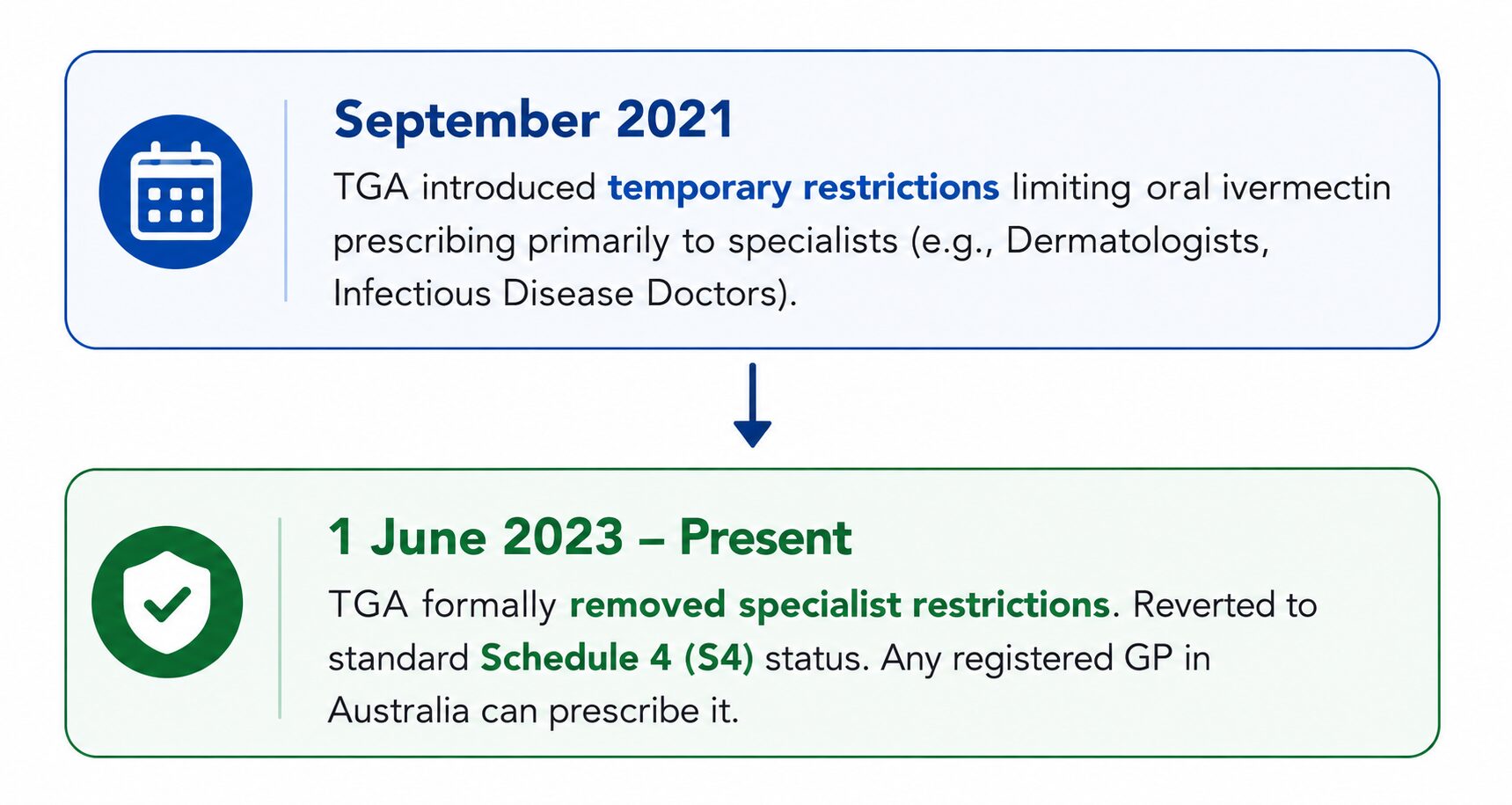
Today, oral ivermectin is back to its standard status as a Schedule 4 (S4) prescription medicine. Any registered General Practitioner in Australia can evaluate a patient and write a prescription if clinically indicated.
Clinical Note: Australian clinical guidelines and the National Clinical Evidence Taskforce do not support using ivermectin for viral respiratory infections such as COVID-19 or influenza, as large-scale clinical trials demonstrated no therapeutic benefit. Its approved use remains strictly for parasitic and dermatological indications.
Recommended Weight-Based Oral Dosage Guidelines
Oral ivermectin is dosed strictly according to patient body weight. Because standard human tablets come in 3 mg strengths, your doctor will calculate the exact number of tablets required for your dose.
Weight-Based Dosing Schedule ($200\ \mu\text{g/kg}$)
| Patient Weight (kg) | Recommended Oral Dose | Number of 3 mg Tablets |
|---|---|---|
| 15 kg to 24 kg | 3 mg | 1 Tablet |
| 25 kg to 35 kg | 6 mg | 2 Tablets |
| 36 kg to 50 kg | 9 mg | 3 Tablets |
| 51 kg to 65 kg | 12 mg | 4 Tablets |
| 66 kg to 79 kg | 15 mg | 5 Tablets |
| More than 80 kg | 200 mg | Dosed according to exact weight |
Pharmacist Tip: If you struggle with swallowing multiple 3 mg tablets at once, swallow them one at a time with a full glass of room-temperature water. Always take your dose on an empty stomach—at least 2 hours before or 2 hours after food—as dietary fats can unpredictably alter how much active medicine your body absorbs.
Why Second Doses Are Needed for Scabies
Ivermectin paralyzes adult mites and active larvae, but it does not destroy unhatched eggs. For scabies, doctors routinely prescribe a second dose 7 to 14 days later. This second dose catches and clears newly hatched mites right as they emerge, before they can reproduce.
Side Effects and Safety Considerations
When taken at prescribed human dosages under medical supervision, oral ivermectin is generally well tolerated. Most side effects are mild, temporary, and often stem from your body’s immune system reacting to dying parasites rather than the drug itself.
Common Symptoms
-
Lightheadedness or mild dizziness
-
Mild nausea, abdominal discomfort, or loose stools
-
Itchy skin or a temporary rash as dead parasites clear
-
General fatigue or mild muscle aches
Precautions
-
Pregnancy & Breastfeeding: Oral ivermectin is generally avoided during pregnancy due to limited safety data. Small amounts pass into breast milk, so alternative therapies are typically preferred for nursing mothers.
-
Paediatric Use: Safety has not been established in children weighing under 15 kg or under 5 years of age.
Critical Warning: Human Tablets vs. Veterinary Products
It is essential to distinguish between human pharmaceutical tablets and veterinary preparations (such as livestock pastes, pour-on liquids, or drench formulas for horses and cattle).
-
Extreme Overdose Risk: Veterinary products are formulated for large livestock weighing 500 kg or more. Concentrated animal pastes make accurate human weight dosing nearly impossible, leading to a high risk of accidental toxicity.
-
Untested Additives: Animal preparations contain chemical solvents and inactive ingredients that have never been evaluated for safe human swallowing.
-
Severe Neurotoxicity: High doses of veterinary ivermectin can breach the human blood-brain barrier, resulting in central nervous system depression, seizures, coma, low blood pressure, and severe organ toxicity.
Safety Warning: Never consume veterinary products. Always use human-grade pharmaceutical tablets supplied through accredited pharmacies under a doctor’s prescription.
Accessing Human-Grade Ivermectin Safely at 24 Hour Meds
If your healthcare professional has prescribed oral ivermectin, sourcing your medication through verified, accredited channels ensures you receive genuine, accurately dosed, human-grade tablets.
At 24 Hour Meds, we facilitate reliable access to legitimate pharmaceutical products across Australia:
-
Genuine Human-Grade Medication: Sourced exclusively via accredited pharmaceutical supply networks.
-
Discreet Express Delivery: Orders are dispatched directly to your door in plain, secure, unbranded packaging.
-
Dedicated Support: Clear guidance and customer assistance for all your health and prescription needs.
Have a valid prescription ready? Visit Generic Ivermectin at 24 Hour Meds to place your order with total confidence.
Frequently Asked Questions
How quickly does ivermectin work in humans?
Absorption is rapid. Peak blood levels are reached approximately 4 hours after oral ingestion. While parasite paralysis begins quickly, physical symptom relief (such as skin itching in scabies) can take several days to two weeks as the skin heals.
Is a doctor’s prescription mandatory in Australia?
Yes. Oral ivermectin is classified as a Schedule 4 (S4) Prescription Only medicine in Australia. A consultation with a registered GP or specialist is required to obtain a prescription.
Does ivermectin kill parasite eggs?
No. Ivermectin targets active larvae and adult parasites by disrupting their nervous systems, but it does not kill unhatched eggs. This is why conditions like scabies require a second dose 7 to 14 days later to kill newly hatched mites before they reach reproductive age.
Is ivermectin used to treat or prevent cancer in humans?
No. Ivermectin is not approved by the TGA or any major global health authority for the treatment or prevention of cancer. While early laboratory (petri dish) research has explored how antiparasitic compounds interact with cells, there is no clinical evidence in human trials showing that ivermectin effectively treats cancer. High doses required to mimic laboratory findings can cause severe neurotoxicity and dangerous interactions with standard cancer therapies. Always consult a qualified oncologist or General Practitioner for evidence-based cancer care. Also read: Exploring Ivermectin and Fenbendazole in Cancer Research – What Australians Should Know
Disclaimer: The information provided in this article is for educational and informational purposes only and does not constitute medical advice, diagnosis, or treatment. Always seek the advice of a qualified healthcare provider or General Practitioner with any questions regarding a medical condition or prescription medication.